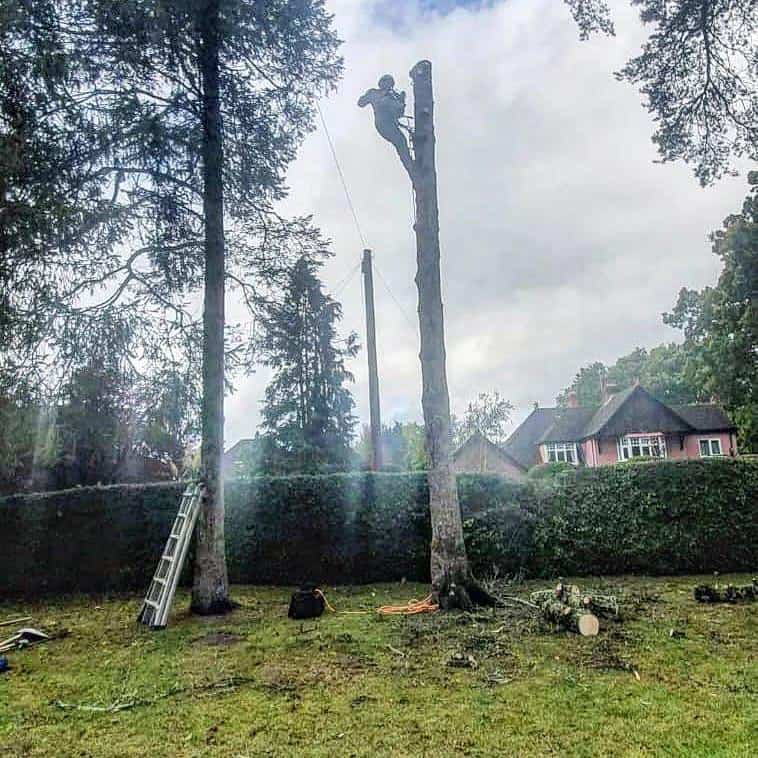
Repeated poor cutting can gradually change the structure, appearance and growth pattern of a tree. Branches may have been removed at unsuitable points, the crown may have become uneven, or heavy pruning may have encouraged dense clusters of vigorous regrowth. After several years, the result can be a tree that bears little resemblance to its natural form and becomes increasingly difficult to manage.
For property owners in Bishop’s Stortford, Essex, professional tree surgery can often help improve a poorly managed tree, but the correct approach depends on what previous cutting has done to it. The objective should not be to remove large amounts of growth simply to make the tree smaller again. Instead, a tree surgeon can assess its current structure, identify problematic growth and determine whether a gradual programme of selective work can improve its condition and form.
How Professional Tree Surgery Can Improve a Poorly Pruned Tree
A tree cannot simply be returned to an earlier stage of development. Once substantial branches have been removed, those original structures cannot be recreated.
However, trees continue responding to pruning and producing new growth. Professional tree surgery can work with the tree’s present structure, managing new growth and addressing defects where appropriate.
In many cases, improvement is therefore possible even though completely reversing years of unsuitable cutting is not.
Poor Cutting Can Change How a Tree Develops
Pruning influences future growth.
When branches are removed appropriately, the remaining tree can continue developing around a considered structure. Poorly positioned or excessive cuts can produce a very different response.
The tree may generate vigorous shoots close to previous cutting points, develop an uneven crown or concentrate growth within particular areas.
Repeating the same cutting method every few years can exaggerate these characteristics.
Heavy Cutting Can Encourage Vigorous Regrowth
It may seem logical that removing a large amount of a tree’s crown will keep it smaller for longer.
In practice, some trees respond to severe cutting with vigorous new growth.
Numerous shoots can develop around previously cut areas and rapidly create a dense crown. The tree may then appear overgrown again much sooner than expected.
Repeatedly cutting this regrowth back heavily can continue the cycle rather than creating a sustainable management approach.
Dense Regrowth May Need Selective Management
Where clusters of new shoots have developed following previous pruning, removing all of them at once is not automatically the best solution.
A professional tree surgeon can assess which growth contributes positively to the developing crown and which shoots may be poorly positioned, crossing or unnecessarily congested.
Selective management can gradually improve the arrangement of branches.
The appropriate approach depends on the species, condition and extent of previous work.
Poor Pruning Can Leave an Unbalanced Crown
Years of inconsistent cutting can leave one section of a tree considerably different from another.
One side may contain dense regrowth while another has relatively few established branches. Lower sections may have been heavily removed while the upper crown has continued expanding.
The aim of professional tree surgery is not necessarily to force perfect symmetry.
Instead, pruning can be planned around the tree’s existing structure, natural growth characteristics and available space.
Large Old Cuts Need to Be Considered
Evidence of previous pruning can remain visible for many years.
Where substantial branches have been removed, large pruning points can become important features within the tree’s current structure.
They should be considered when deciding how future growth is managed.
Simply making additional large cuts nearby without understanding the existing structure can compound previous problems rather than improve them.
Poor Branch Selection Can Create Crowded Growth
Repeated pruning without a clear objective can result in too many branches developing within particular parts of the crown.
Branches may cross, rub or compete for the same space.
Selective pruning can sometimes improve this situation by identifying which branches should remain and which growth is contributing to unnecessary congestion.
This is very different from indiscriminately thinning the entire tree.
Crossing Branches May Require Attention
Branches that repeatedly rub against one another can develop damaged areas where their surfaces meet.
Not every crossing branch needs removing, particularly within a mature tree where unnecessary pruning should be avoided.
However, where competing branches are creating an obvious structural or practical problem, selective work may be appropriate.
Professional assessment helps determine which branch, if any, should be removed while retaining useful growth.
Deadwood Can Develop Within a Poorly Managed Crown
A dense or repeatedly cut crown can make it difficult to identify dead branches from ground level.
Deadwood can become concealed behind vigorous new growth.
Where significant dead branches are present, selective removal may form part of the overall tree surgery work.
This can be carried out alongside other appropriate pruning rather than treating every visible problem as a reason for extensive crown reduction.
Previous Topping Can Create Long-Term Management Challenges
Severe removal of the upper crown can dramatically change how a tree grows.
Rather than creating a naturally smaller version of the original tree, the response may include multiple vigorous shoots developing around old cutting points.
As this new growth becomes larger, the tree can require further management.
Professional tree surgery cannot undo the original cuts, but it may be possible to manage subsequent growth more carefully and establish a more appropriate long-term approach.
Repeating the Same Poor Cutting Can Make the Problem Worse
A common problem occurs when a tree is cut heavily because it has become overgrown, produces vigorous regrowth and is then cut back heavily again.
Each cycle can make the tree increasingly dependent on repeated intervention.
Changing the management strategy can be more effective than simply repeating what has been done previously.
A professional assessment can determine whether more selective pruning would provide a better approach for the tree’s present condition.
Crown Reduction May Sometimes Be Appropriate
If the tree has become too large for its surroundings, crown reduction may be considered where suitable.
Professional crown reduction aims to reduce the overall dimensions while retaining a balanced framework and selecting appropriate pruning points.
This differs significantly from indiscriminately cutting branches back to an arbitrary height.
The amount of reduction that is appropriate depends on the tree itself. A previously heavily pruned tree may require particularly careful consideration before further substantial growth is removed.
Crown Thinning Has a Different Purpose
A dense tree does not necessarily need to be made substantially smaller.
Where appropriate, selective crown thinning can reduce particular areas of congestion while largely retaining the overall size and shape.
This may be relevant where previous poor pruning has contributed to dense internal growth.
However, thinning is not automatically appropriate for every tree, and excessive removal can create additional problems.
The decision should be based on the actual crown structure.
Selective Pruning Can Be More Useful Than Heavy Reduction
When attempting to improve a poorly managed tree, careful branch selection is often more important than simply removing a large quantity of growth.
A small number of well-chosen cuts can sometimes improve branch relationships more effectively than widespread pruning.
This requires considering what each branch contributes to the future structure.
Professional tree surgery should therefore have a clear objective rather than measuring success by how much material has been removed.
Improvement May Need to Take Place Gradually
A tree affected by many years of unsuitable pruning may not be best managed in a single intensive visit.
Attempting to correct every structural and visual problem at once could require removing too much living growth.
In suitable circumstances, staged management may allow selected work to be carried out before the tree’s response is reassessed later.
This creates an opportunity to work progressively with new growth rather than attempting to impose an immediate shape through excessive cutting.
The Tree’s Natural Form Still Matters
Different tree species naturally develop different crown shapes.
Some have broad spreading crowns, while others develop more upright or compact forms.
Trying to force every tree into the same shape can result in inappropriate pruning.
Even when previous cutting has significantly altered the crown, understanding how that particular tree naturally grows can help guide future management.
The aim should be a practical and appropriate structure rather than an artificial shape that requires continual severe pruning to maintain.
Not Every Imperfection Needs Correcting
A tree affected by previous poor pruning may never look perfectly symmetrical.
That does not necessarily mean additional branches should be removed.
Some irregularities can remain without preventing the tree from being successfully managed.
Unnecessary attempts to create visual perfection can lead to further pruning that provides little practical benefit.
Professional tree surgery prioritises meaningful improvements rather than cutting simply because a branch looks slightly different from its neighbours.
New Growth Needs to Be Judged on Its Role
Regrowth following previous cutting is not automatically unwanted.
Some new branches may contribute positively to the tree’s developing structure.
Others may be excessively dense, poorly positioned or competing with more useful growth.
The important task is distinguishing between them.
Removing all new shoots indiscriminately can prevent the crown from developing a more sustainable framework.
Tree Surgery Can Also Improve Practical Clearance
Poorly managed trees can develop branches in inconvenient locations.
Regrowth may extend over lawns, paths, seating areas or other frequently used parts of the garden.
Where appropriate, selective pruning or crown lifting can improve clearance while retaining suitable branches elsewhere.
This allows practical garden requirements to be considered without automatically applying a heavy reduction to the complete tree.
Dead, Damaged and Poorly Positioned Growth Can Be Prioritised
When several problems are present, it can be useful to establish priorities.
Dead or damaged branches may deserve attention before purely cosmetic irregularities. Problematic crossing growth can then be considered alongside the wider crown structure.
This prevents tree surgery from becoming an attempt to address every perceived imperfection simultaneously.
A clear sequence of priorities can produce a more measured management approach.
A Poorly Cut Tree Does Not Automatically Need Felling
A tree that looks untidy after years of inappropriate pruning is not necessarily beyond management.
If its overall condition and structure allow, professional tree surgery may provide opportunities to improve the crown gradually.
Felling should not be assumed simply because the tree has previously been managed badly.
The appropriate response can only be determined after considering the individual tree and the extent of the problems present.
Some Previous Damage Cannot Be Reversed
It is important to have realistic expectations.
Tree surgery can manage current growth and potentially improve future development, but it cannot restore branches that were removed many years ago.
Large historic cuts and permanent changes to the original framework may remain part of the tree.
The aim is therefore not to recreate the tree exactly as it once was. It is to determine how the existing tree can be managed appropriately from its current condition.
Future Pruning Should Have a Clear Objective
Once improvement work has begun, future pruning should avoid returning to the previous cycle of indiscriminate cutting.
Each intervention should have a reason.
That may include managing dimensions, maintaining clearance, removing deadwood or selectively improving crown structure.
Having a defined objective helps prevent unnecessary cutting and allows the tree’s development to be managed more consistently over time.
Professional Assessment Determines What Can Realistically Be Improved
Two trees that have both experienced years of poor pruning can require very different approaches.
The species, age, extent of previous cutting, current crown structure, amount of regrowth and condition of major branches all influence what can reasonably be achieved.
At Bishop’s Stortford Tree Surgeons, we assess poorly managed trees in Bishop’s Stortford, Essex before determining an appropriate tree surgery approach.
Where improvement is possible, the focus can be placed on carefully selected work that responds to the existing tree rather than repeating the heavy or unsuitable cutting that created the problem.
Conclusion
Professional tree surgery can often help a tree that has been affected by years of poor cutting, but improvement requires a considered approach. Heavy pruning can encourage vigorous regrowth, create crowded branches and leave the crown unbalanced, while repeatedly using the same cutting method can make these problems more difficult to manage.
The solution is not necessarily to cut the tree heavily again. Selective pruning, appropriate crown management, deadwood removal and gradual improvement may provide a more suitable way forward, depending on the tree’s current structure and condition.
If you have a tree in Bishop’s Stortford, Essex that has become misshapen, excessively dense or difficult to manage following previous pruning, contact Bishop’s Stortford Tree Surgeons. We can assess how the tree has responded to earlier work and recommend an appropriate tree surgery approach based on what can realistically and beneficially be achieved.
Call us on: 01279 744 495
Click here to find out more about Bishop’s Stortford Tree Surgeons
Click here to complete our contact form and see how we can help with your tree care needs.